Can Digital Solutions and IoT Help Reduce Business Interruption?

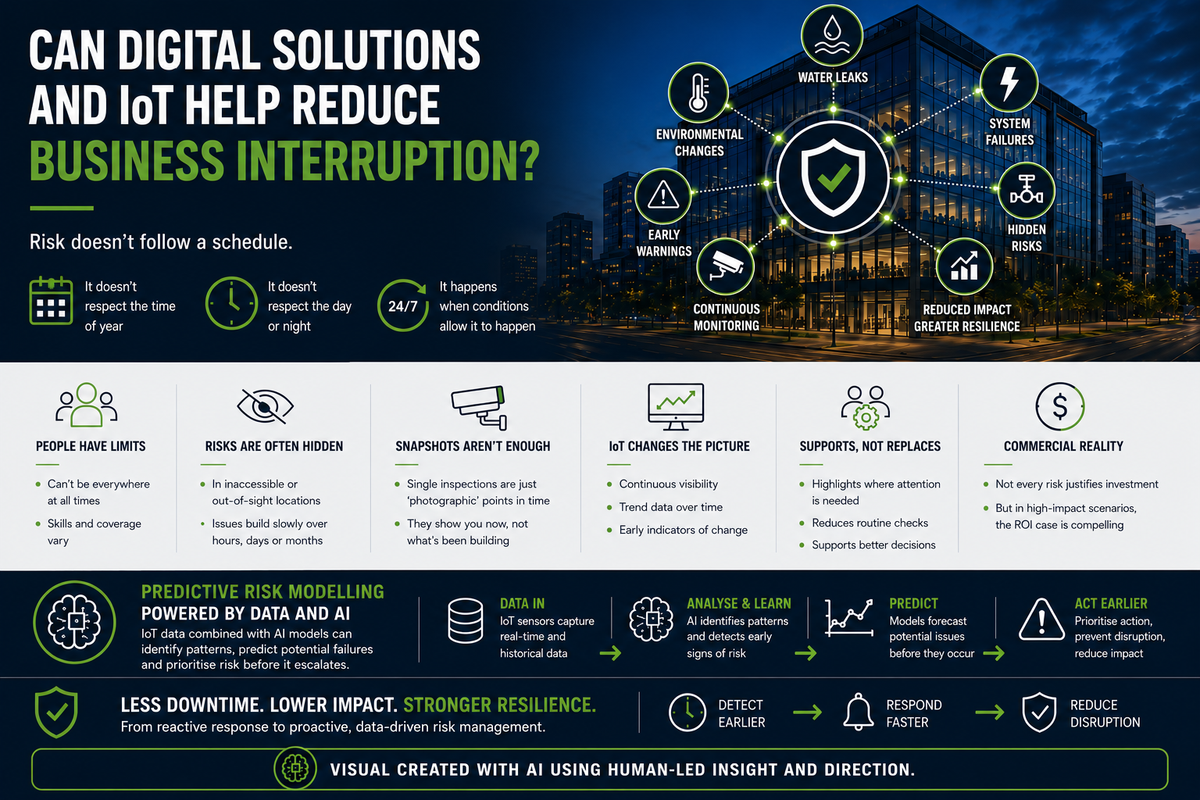
Business interruption doesn’t follow a schedule.
It doesn’t respect:
- Time of year
- Day or night
- Operational convenience
>> It happens when conditions allow it to happen.
The limits of relying on people alone
Most organisations rely on people at asset locations to identify issues.
That provides a level of protection — but it has clear limitations:
- People can’t be everywhere at all times
- Coverage is intermittent, not continuous
- Skill sets vary across teams
>> Which means:
Risk is often only identified once it has already developed
Where risk builds
Many events that lead to business interruption:
- Develop slowly over time
- Sit in hidden or inaccessible areas
- Go unnoticed during day-to-day activity
>> Examples include:
- Slow escape of water
- Environmental changes leading to mould
- Mechanical or system degradation
- Issues within risers, voids or plant areas
The problem with point-in-time checks
Inspections — whether conscious or subconscious — are:
>> Single “photographic” points in time
They tell you:
- What is happening right now
But not:
- What has been building
- What is changing
- What is about to happen
>> Which creates a very limited view of risk
Where IoT changes the picture
IoT introduces something fundamentally different:
>> Continuous visibility
Instead of snapshots, you get:
- Ongoing monitoring
- Trend data over time
- Early indicators of change
Where predictive risk modelling adds value
Continuous visibility is the foundation.
But the real step change comes when that data is used to look forward — not just back.
>> Predictive risk modelling
By combining IoT data with analytics and AI, organisations can:
- Identify patterns across time
- Detect subtle changes that indicate emerging risk
- Forecast potential issues before they occur
From data to foresight
Instead of asking:
>> What is happening right now?
You start to ask:
>> What is likely to happen next?
How it works in practice
- IoT sensors capture real-time and historical data
- Models analyse trends and learn normal behaviour
- Anomalies and patterns are identified early
- Risk is prioritised before it escalates
>> The result:
- Earlier intervention
- More targeted response
- Reduced likelihood of disruption
Supporting, not replacing, teams
IoT doesn’t replace people.
It enhances them.
- Highlights where attention is needed
- Reduces reliance on routine checks
- Supports better decision-making
>> Allowing teams to focus where they add the most value
The commercial reality
Not every risk justifies investment.
If potential business interruption is minor:
>> The ROI may not stack up
But in higher-impact scenarios:
- Critical environments
- High-value assets
- Potential for high levels of business interuption
- Locations with downstream dependencies
>> The case becomes much stronger
For example:
A facility located above a high street retail environment
→ even a small issue can lead to significant disruption and cost
The takeaway
Business interruption is rarely caused by a single event/dynamic.
It’s often the result of:
- Time
- Lack of visibility
- Delayed response
IoT helps break that chain.
From:
Reactive response
To:
Proactive — and increasingly predictive — risk management
If this is relevant to what you're working on, feel free to reach out.
#IoT #SmartBuildings #BuiltEnvironment #RiskManagement #BusinessContinuity #DataDriven #DigitalTransformation #OperationalEfficiency #PropTech #Resilience