The Property Lifecycle and IoT

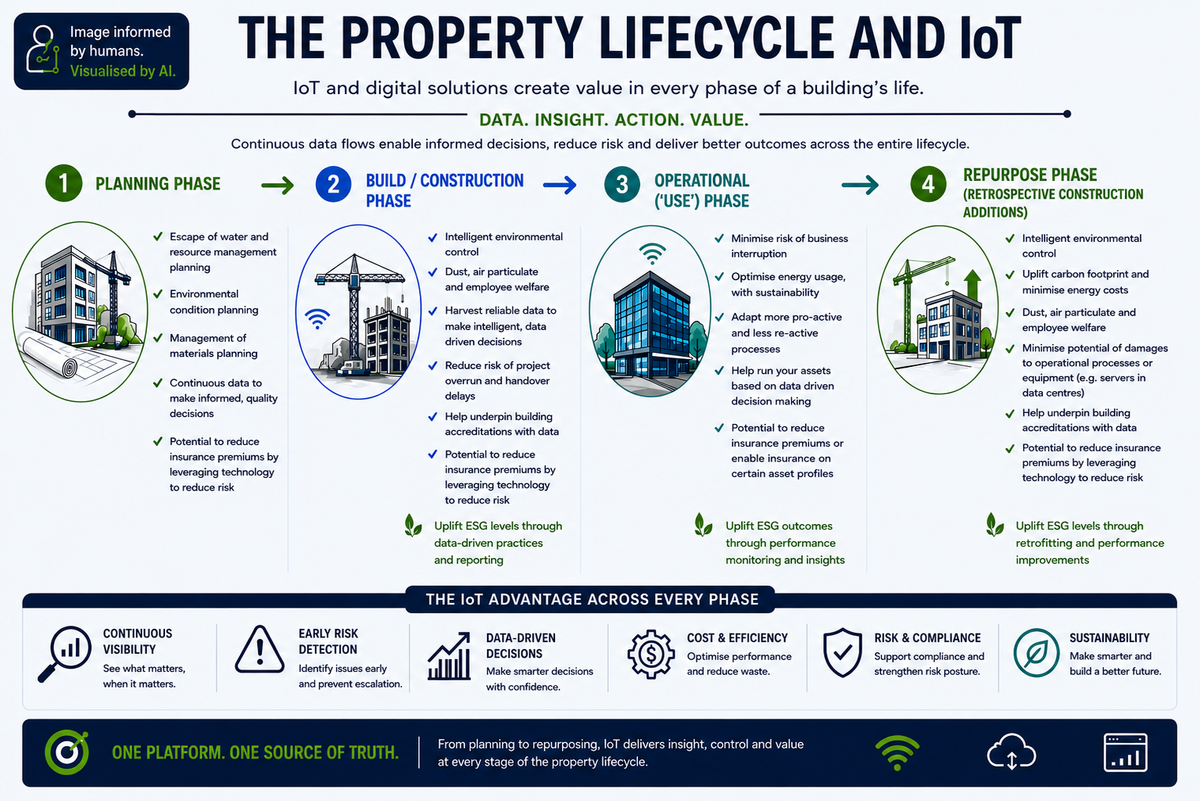
IoT and digital solutions aren’t confined to a single phase of a building’s life.
>> They can add value from planning through to repurposing
At a high level, this post outlines where that value sits across the lifecycle.
I’ll go deeper into each area in future posts — but if anything resonates, feel free to reach out in the meantime.
Planning phase
The opportunity to reduce risk starts before construction begins.
Escape of water and moisture management
At a conference a couple of years ago, I heard a statistic:
>> Around 50% of construction-phase insurance claims are water-related
>> Yet more than 50% of projects have no formal moisture management plan
That gap presents a clear opportunity.
Environmental condition planning
Construction happens:
- Year-round
- Across varying climates
- With materials that respond differently to environmental conditions
Certain materials — such as mass timber — are highly sensitive to moisture and temperature.
>> Planning for these conditions early reduces downstream risk
Materials management
If materials arrive before a site is ready:
>> They need to be stored
For sensitive materials:
- Environmental control becomes critical
- Poor storage can introduce latent defects
>> Continuous monitoring provides confidence and control
Data-led planning decisions
Introducing data early enables:
- Better-informed decisions
- Higher build quality
- Reduced risk exposure
>> And in some cases:
Technology-led risk reduction can positively influence insurance premiums
Build / construction phase
This is where IoT becomes highly visible and operationally valuable.
Environmental control
Maintaining the right conditions:
- Protects materials
- Supports quality outcomes
- Can optimise energy usage and carbon impact
Concrete curing optimisation
Data-led monitoring enables:
- Better curing conditions
- Improved structural integrity
- Reduced rework risk
Dust, air quality and employee welfare
Monitoring:
- Dust levels
- Air particulates
- Environmental conditions
>> Helps protect both:
- Workforce health
- Project timelines
Reducing risk of project overrun
Delays between construction and operational handover are high-impact.
>> Real-time data enables:
- Faster response to issues
- Reduced likelihood of delays
A good example:
Stabilising dust levels before handing over a data centre
→ critical for protecting sensitive equipment
Data as a foundation
During construction, IoT enables:
- Continuous data capture
- Data-driven decisions
- Reduced risk of defects at handover
>> It also supports:
- Building accreditations
- Compliance requirements
Operational (‘use’) phase
Once a building is live, the focus shifts to performance, efficiency and risk.
Minimising business interruption
- Early detection of issues
- Faster response
- Reduced impact of failures
Energy and sustainability optimisation
- Data-driven energy management
- Reduced operational costs
- Improved sustainability outcomes
From reactive to proactive
- Continuous monitoring replaces periodic checks
- Data informs decision-making
- Risk is managed earlier
Insurance and risk profile
In some cases:
- Risk reduction can lower premiums
- Or enable insurance for complex asset profiles
Repurpose phase (retrospective construction / upgrades)
Buildings evolve — and so do their requirements.
IoT plays a key role in enabling safe and efficient change.
Environmental control and protection
- Maintaining conditions during upgrades
- Protecting existing operations
Construction within live environments
- Dust and air quality control
- Protection of operational processes
- Minimising disruption
>> Particularly critical in environments such as:
- Manufacturing
- Data centres
Data-driven assurance
- Monitoring conditions during works
- Reducing risk to existing infrastructure
- Supporting compliance and accreditations
The common thread
Across every phase of the lifecycle:
>> The value comes from data
- Continuous visibility
- Better decision-making
- Earlier intervention
The takeaway
IoT isn’t a point solution.
It’s a lifecycle capability
From:
Planning
Through:
Construction
Into:
Operation and repurposing
>> It provides a consistent layer of insight, control and risk management throughout.
If this is relevant to what you're working on, feel free to reach out.
#IoT #SmartBuildings #BuiltEnvironment #DigitalTransformation #DataDriven #Construction #PropTech #OperationalEfficiency #Sustainability #RiskManagement