The Relationship Between BMS and IoT

This is a frequent discussion in my world — and there isn’t a single “right” position.
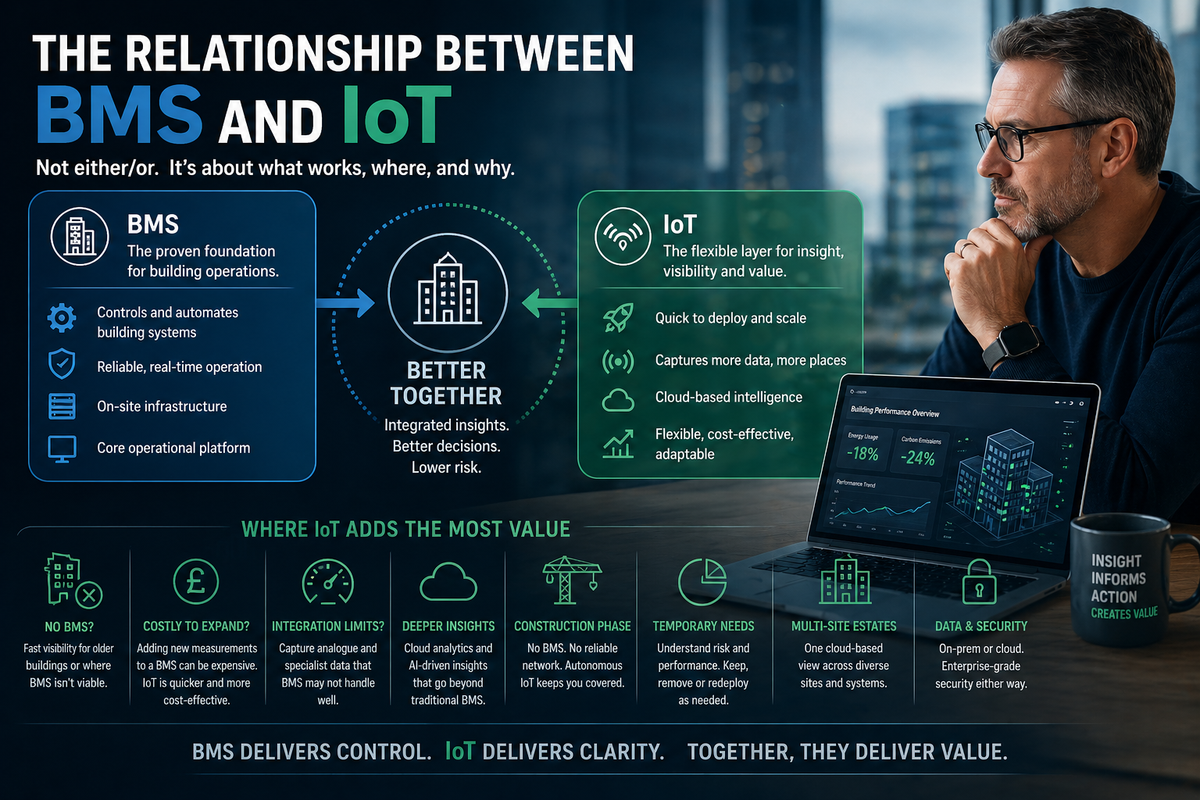
BMS and IoT aren’t competing solutions.
In most cases, they are complementary, and understanding where each fits is where the value sits.
Where IoT naturally fits
There are a number of common scenarios where IoT solutions are a strong fit:
No existing BMS
Older assets or smaller facilities often don’t have a BMS, either due to age or cost.
IoT provides a fast, low-friction way to introduce visibility.
BMS exists, but expansion is costly
Many sites have a BMS in place, but extending it to capture additional data points can be expensive and time-consuming.
Integration limitations
Some BMS platforms handle digital states very well but are less effective with more granular analogue measurements or newer sensor types.
Specialist insight requirements
Generating meaningful insights — particularly around risk — often requires cloud-based processing and specialist interpretation.
In these cases, IoT can sit alongside the BMS and even feed intelligent alerts back into it, avoiding the need for operational teams to work across multiple systems.
Blending and unlocking wider data sets
IoT platforms are often more agile when it comes to ingesting, blending, and analysing varied asset data sets.
This flexibility enables new insights to be uncovered across systems and asset types — leading to more informed, value-adding actions.
Construction and commissioning phases
During construction, there is typically no BMS in place for the majority of the project lifecycle.
Reliable site connectivity can also be limited.
In these environments, autonomous IoT solutions are often the only practical option.
As BMS systems come online, IoT can play a valuable role in testing, validation, and handover, helping ensure that buildings perform as designed.
In many cases, IoT remains in place even after commissioning — particularly where flexibility is required.
Wireless sensors can be easily repositioned, which is useful when validating real-world performance against design assumptions.
Evolving building requirements
The increasing adoption of building standards and sustainability targets is driving demand for new data points.
Energy and environmental performance are now front and centre — and these data sets are not always available through existing BMS infrastructure.
IoT solutions are well aligned to fill that gap.
Temporary insight vs permanent infrastructure
Not all use cases require permanent deployment.
Many stakeholders simply want to understand risk or characterise building performance.
In these cases, IoT offers a flexible approach:
- Deploy quickly
- Gather insight
- Act if required
If the risk is low, the solution can be removed and redeployed elsewhere.
If the risk persists, it can remain in place.
Multi-site portfolios
For organisations managing multiple sites, consistency is often a challenge.
BMS systems can vary significantly across an estate — different vendors, different capabilities, and sometimes no system at all.
IoT provides a way to create a standardised, cloud-based view across the portfolio, enabling more consistent risk management and decision-making.
Data and security considerations
In some sectors, there is a firm requirement for data to remain on-site.
These environments often favour traditional BMS approaches.
That said, modern IoT platforms now operate with enterprise-grade security, and the gap is narrowing.
Single interface, unified alerts
When it comes to user interfaces, there is understandably little appetite for managing multiple systems.
This shouldn’t be a blocker.
Where valuable alerts and operational insights are generated within an IoT solution, these can be channelled into the existing BMS — ensuring the right stakeholders are notified through familiar workflows.
This approach allows organisations to benefit from enhanced insight and coverage, without adding complexity to day-to-day operations.
This is an area that often generates a lot of discussion, but when you break it down to what’s actually needed operationally, pragmatic, low-friction solutions are readily available.
A practical example
I was involved in a project with a state-of-the-art, newly built facility, equipped with a modern BMS.
On the surface, everything looked covered.
However, there were still blind spots in the asset data the client actually needed.
Two challenges quickly emerged:
- Introducing additional measurements through the existing BMS was very costly
- Gaining access to the raw data for external analysis came with a significant price tag
To be clear, this isn’t always the case — but it can happen once systems and commercial models are locked in.
In this instance, IoT provided a pragmatic way to reintroduce visibility — filling those data gaps without the cost and complexity of reworking the incumbent system.
The takeaway
This isn’t a case of BMS or IoT.
It’s about understanding how the two can work together.
BMS provides control and core operational infrastructure.
IoT provides flexibility, additional insight, and speed of deployment.
Used together, they create a far more complete picture of building performance and risk.
#IoT, #BMS, #SmartBuildings, #BuiltEnvironment, #DigitalTransformation, #DataDriven, #BuildingPerformance, #PropTech, #OperationalEfficiency, #Sustainability